
17th May 2024
Many of us have a ‘drawer of doom’. Among the old post-it notes, dried-out pens, tarnished coins and random hair accessories usually lie used batteries – from AAs and AAAs to button cells and torch batteries. And don’t forget the other items with hidden batteries that we stash away in cardboard boxes and cupboards, like old mobile phones, vapes or kids’ toys.
There’s little point in holding onto these batteries and unused electricals. But when you do get around to disposing of them, never put them in the bin!
Why you should never bin hidden or loose batteries
When hidden and loose batteries are thrown in with general rubbish, they can get crushed in bin lorries and at recycling centres and spark dangerous fires. Last year alone, there were over 1,200 preventable battery fires across the UK, which led to significant air pollution spikes and danger to the local community.
Batteries also contain some of the most valuable materials on earth that are infinitely recyclable. We lose these materials forever when we throw batteries and electricals containing hidden batteries in the bin.
So remember to always recycle them separately from your household rubbish or recycling by using a designated drop-off point for batteries and electricals.
Fire services warns of the dangers
Battery-related fires are particularly challenging to deal with because of the hazardous chemicals. “These fires can be explosive and spread rapidly with the risk of reignition and toxic gasses a risk to firefighters,” explains Mark Andrews, Waste and Recycling Fires Lead for the National Fire Chiefs Council. “To control and fully extinguish the fire requires large numbers of firefighters and drains finite fire service resources, creating further risks to the community.”
“You only have to view live footage of a lithium-ion battery fire to see the scarily rapid rate of development which makes these incidents particularly hazardous and volatile,” adds James Bull, Station Commander for Hertfordshire Fire and Rescue Service. “They can take many fire service resources to tackle them and they are notoriously difficult to extinguish given that the flame heat release rate from a lithium-ion battery fire can be 7 times more intense than a traditional flame.”
These preventable fires are not only time consuming for firefighters, but also unnecessarily endanger their lives and the lives of those working on lorries and at waste plants.
The impact of battery fires on the community
Battery fires are not only putting fire services and waste plant staff at risk; they also have a significant impact on local communities.
Herne Hill in South London experienced a battery fire last September (2023), where a fire broke out at a waste transfer station caused by a binned battery. The fire lasted over 4 days, covering a very densely populated area in a pall of smoke.
Families like Bethan Taylor-Smith’s faced dangerous repercussions. “We live half a mile from the scene of the fire and the smoke was so bad we were advised to close our windows and stay indoors for the duration of the incident – four days, in the middle of a heatwave! My toddler started having breathing issues and developed a cough, and things got so bad we visited a walk-in centre and eventually A&E. In the end, we went to stay with family for a few days so that our daughter and dog could enjoy time outside.”
“We were all concerned about the length of time that the fire burned for and how this affected the local community, especially given how some residents were forced to move out of the area because of the impact this had on their health and due to the fact they were unable to go outside during a national heatwave,” adds Councillor Jim Dickson, Herne Hill Ward & Cabinet Member for Health and Social Care, Lambeth. “Fires like these could be so easily prevented by ensuring that batteries are recycled.”
Battery fires are causing air pollution spikes
Battery fires like this also cause significant spikes in air pollution, as found by Professor Frank Kelly from the Faculty of Medicine, Imperial College London. “Our analysis of fires at waste sites in Herne Hill and Brentford showed they contributed to the local pollution burden, with the fire in Herne Hill clearly leading to exceedances in the WHO health-based guideline for PM2.5.”
Air pollution is not only a serious environmental concern, but a health concern too. Studies show that spikes cause hundreds of cardiac arrest and strokes in the UK and particularly affect those with health conditions.
“The health impacts of waste fires, including respiratory issues, are of great concern, and we’d advise that residents avoid opening windows at all costs while local air pollution concentrations are elevated and that everyone should wear a mask if they absolutely must venture outside while the fire is burning,” adds Professor Kelly. “The status of local air quality can be checked on www.londonair.org.uk”.
The science behind battery hazards
It’s easy to think something so small won’t matter. But if we throw batteries and electricals in with our general rubbish, they can get crushed or punctured in bin lorries and waste centres. This releases chemicals, which, when they come into contact with the air, can spark serious and dangerous fires.
Battery-related fires can be explosive and spread rapidly, with re-ignition and toxic gases posing a huge risk to firefighters.
Such incidents also pollute the atmosphere and cause health issues for local residents, schools and businesses, raising serious concerns among public health officials and firefighters.
Getting rid of your old batteries and electricals
“Something as simple as recycling your small electricals correctly can go a long way in preventing lithium-ion battery fires,” Laura Fisher, re3 Operational Manager for FCC Environment.
The only safe way and responsible to dispose of old batteries and electricals is by recycling them. Make sure you recycle them separately from your household rubbish and recycling. Find a designated drop-off point for batteries and electricals.
28th March 2024
Decluttering extraordinaire Vicky Silverton shares her top tips for decluttering your home of old electricals, and how to get organised to sell, donate or recycle them.
Written by decluttering expert, Vicky Silverthorn
The key is to get started and stop seeing your home as one giant task that you have an urgency to complete. Chipping away at your home is a great way to declutter, so start with something small like a drawer or a shelf, nothing more.
People often get disheartened when they don’t initially get rid of as much as they’d have hoped to. Don’t worry if you feel like that. Letting things go can be a really emotional process. You can feel really attached to things sometimes, even if they’re just functional items with no sentimental attachment. Always revisit areas you have worked on days or weeks later and you’ll probably find you pick out additional items to go

#1 Get organised
If you are having a clear out of your home, get your rubbish bag, recycling bag, box for charity and box for any electrical recycling at the ready. You need somewhere to put things so you’re not tempted to just shove them back in the cupboard. If you are selling old electricals, be realistic as to how much time you have to get this done. You don’t want to end up storing bags and bags of resale belongings which you simply don’t have the time to sort, list and post.
#2 Small wins are better than no wins!
It doesn’t matter how much you get through, as long as you follow a simple rule – only start an area you can complete. Work on it, complete it and then stop. If you leave an area unfinished at the end of the day, it can leave that defeated feeling and you may not want to begin again. The aim is to finish on a high – even tackling small areas can give you the biggest buzz.
#3 Don’t let tech stop you in your tracks
What to do with old technology often makes people stop in their tracks when they’re having a clear out. Why don’t we want to get rid of it? Perhaps because it could still be useful or it cost a lot? See the potential if we donated or recycled old technology. The alternative? It will sit in a box for the next ten years when it could be having a second life. Don’t forget to remove batteries from old electricals! These should always be recycled separately, as otherwise they can cause fires in the waste stream.
#4 Don’t make ‘bin’ your decluttering default
You may be surprised that the majority of things you clear out can be reused or recycled. Do some research and check out Recycle Your Electricals website for information on what to do with your old electricals – did you know anything with a plug, battery or cable can be recycled – including the plugs, batteries and cable themselves? Clothes, shoes, books, wood, toys, ornaments, batteries, other small electricals – there is somewhere for all of it to go and you’re likely to have a drop off point near you – just check out the Recycling Locator which has a whopping 22,000 places you can recycle your electricals.
#5 A simple snap can save a lot of space
Did you know a photograph of an object can spark the same memory as the actual object itself? This means you don’t always need to keep an item you are holding onto sentimentally! This is especially useful for bulky items you are only keeping because they have memories attached to them. Try taking a photograph and see how it makes you feel. It may help you let go and clear the space.
Remember, anything with a plug, battery or cable, and it’s made so easy by using Recycle Your Electricals’ Recycling Locator. Happy decluttering!
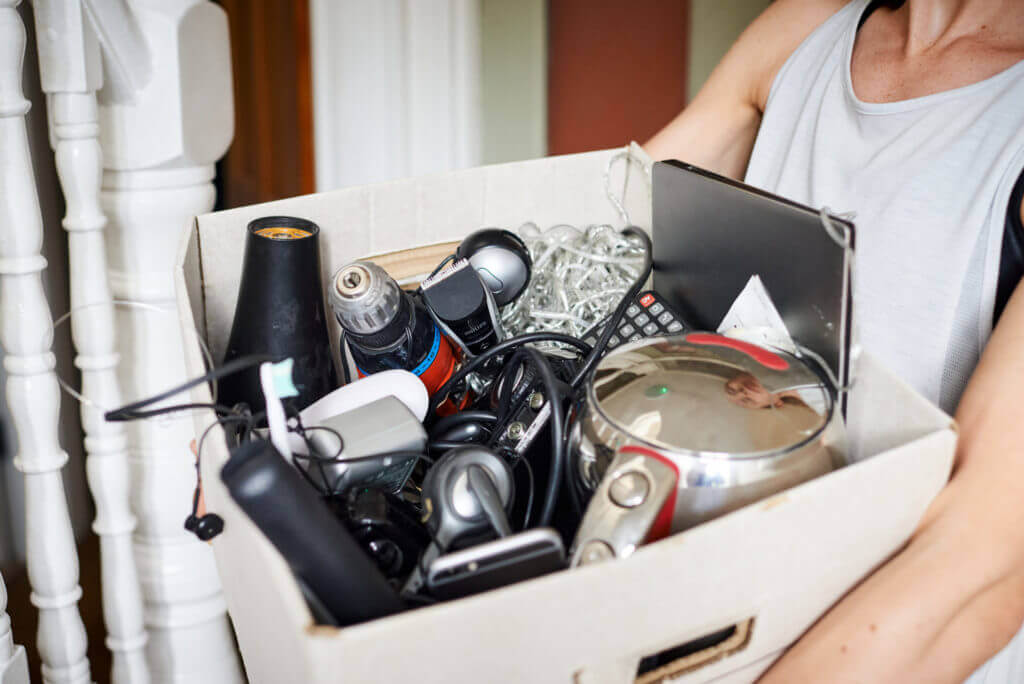
Moving house is an exciting time. It is a great opportunity to declutter, deciding what will and won’t come with you to your new home. It is also a perfect time to sort things into what you want to keep, sell, donate or recycle!
We’re all about making sure we recycle and reuse materials. With August being the most popular month for moving, we’ve prepared our top packing tips to help you have a more eco-friendly house move.
- Reuse cardboard boxes – Try not to buy new boxes that you may not use again. Your local grocery shop may have spares you can use; platforms such as Freecycle, Olio, Facebook Marketplace or other neighbourhood community groups and apps are also a good place to look. Otherwise try searching for ‘rent packing boxes near me’.
- Avoid bubble wrap – Popping bubble wrap is fun for sure, but reducing the amount of plastic we use makes a huge difference to the environment. When packing fragile items, ask around to see if anyone you know has bubble wrap they no longer need, or try wrapping them in eco-friendly packing materials such as tea towels or newspaper.
- Reduce journeys – Making as few trips as possible between your old and new home is great news for the planet! Decluttering before you move will help with this, making more space for your essentials and meaning fewer trips.
- Reduce food waste – Don’t waste the food that you have in your freezer or cupboards that you think you can’t take with you. BBC Good Food and Tesco have lots of useful tips online about what to do with leftovers. Or you can donate leftover food to local food banks or share with neighbours and local businesses on the app Olio.
- Make a smart move – If you need help with your move, try choosing an environmentally-friendly and green removal company. Have a look at their website for any green credentials like whether they are carbon neutral, use electrical vehicles and recycled packaging.
- Donate, sell or recycle your electricals – Packing up your home is the ideal time to sort through all your old, unwanted and broken electricals. Why not divide them into 3 piles: Donate for electricals that are still in good working condition; Sell for those that can be sold online or at a car boot sale; and Recycle for those that are broken and unrepairable. Anything with a plug, battery or cable should always be recycled, including kettles, toasters, electric toothbrushes, drills and TV remotes. Everyday electricals are full of precious materials that can be turned into anything from children’s playgrounds to lifesaving equipment..
To find your nearest recycling point and to start recycling your electricals check out our postcode locator.
14th June 2024
Written by Will Treharne
We’ve all been there… It’s the end of the university year and you suddenly realise you have more stuff to pack up! From that upgraded phone and the blender that broke to the unused lamp sat under your bed, figuring out what to do with these items can be daunting.
Many students we have spoken to aren’t sure what, how or where to recycle, sell or donate their old electricals.
That’s why we’ve created some top tips for what to do with your old electricals at university – whether you’re moving out at the end of term or just looking to declutter!
5 benefits of reusing and recycling your old electricals
- Make money from your old electricals
If your electricals are still in good working condition then selling them is always a great option to make some extra cash. Our research shows that you could make over £1,000 from selling your old electricals online, depending on what you own and their condition. Check out our blog for tips on how to start selling your electricals online. Many companies will also trade in your old phone, laptop, headphones and other electricals for cash or money off your next purchase. Currys’ ‘Cash For Trash’ scheme offers at least £5 off your next purchase for any old tech items you recycle in store. Read our blog on how to make money on your old electricals for more information. - Tidy space, tidy mind!
Freeing up your space by sorting out your old electricals make your home or workspace feel more spacious and organised. A clutter-free environment is also proven to reduce stress levels and promote a sense of calm – perfect during exam season! - Recycling is good for the planet
We know students are passionate about the environment, and recycling your electricals is a quick and easy way to do your bit for the planet. Recycling unwanted electricals means valuable materials like gold, silver and copper get a new lease of life. If we recycled all our old electricals, we could cut as much CO2 as taking 3.8 million cars off the road!
- Help someone in need by donating old electricals
With ongoing coursework, exams (or having some much-deserved fun!) you may feel not have time to sell your electricals. Donating your working electricals is an easy way to pass on your old electricals – and means someone else can use it! A lot of charity shops will be happy to take your working electricals and rehome them with someone who needs them. Find out more about donating your electricals here.
- Save materials and money by repairing
More and more students want to fix their broken electricals before buying new items. Repairing old electricals not only has great environmental benefits, but can save you money too. Take a look at our repair page for more information on how and where you can repair your broken electricals – or learn how to do it yourself!
Recycling at university: getting started
- Remember – anything with a plug, battery or cable can be recycled!
Electric toothbrushes, laptops, lamps, computer keyboards, toasters and anything else with a plug, battery or cable contain precious materials that can be reused and recycled into new things – like children’s playgrounds and lifesaving medical equipment. So keep this in mind whenever you’re clearing out your old gadgets! Find out more about what can be recycled if you are still unsure. - Keep organised with a bag or box
To keep you organised throughout the year, keep a box or bag in your room or the house and use it for old batteries, cables, broken bulbs, and other unwanted electricals. Once the bag is full you can take them all at once to a recycling point – saving you multiple trips throughout the year! Plenty of retailers will take back old electricals too, if you’re popping into town and want to empty that bag. Your future self will thank you! - Simplify the stress
Clearing out or packing up at the end of uni can be overwhelming. A way to make the job less stressful could be sorting your old electricals into piles: ‘Repair’ for broken electricals that could be salvaged; ‘Donate’ or ‘Sell’ for electricals that are still in good working condition and could be sold online or go to another home; ‘Recycle’ for those that are unrepairable and can be recycled into something new; and ‘Keep’ for those working electricals you don’t want to let go of! Watch Konnie Huq and Nicola Lewis’ video for inspiration. - Prepare your electricals before passing them on
Check if your electricals are ready to be passed on before they are sold, traded in, donated or recycled. Do your old electricals contain batteries that can be removed safely? If so, make sure you recycle them at a designated battery recycling point as binned batteries can spark serious and dangerous fires. If not, recycle the whole electrical at your local electrical recycling point. Take out memory and SIM cards, and remember to delete any personal data from smart devices – read our FAQs for more information on how to do this.
- Find your local repair, donation and recycling drop-off points
So you’ve gathered up your old and unwanted electricals… but what next? Simply pop in your postcode into our recycling locator along with the items you have to repair, donate or recycle, and it will show you all of your local recycling centres, retailers, community bring banks and other drop-off points. There may even be a recycling point in your university! Some recycling centres will only allow cars inside. If you don’t own a car, you can easily recycle your old electricals for free at your local electrical retailer under the Retailer Take-back scheme. Some retailers will recycle on a like-for-like basis; other retailers like Curry’s, B&Q and John Lewis will take back any electricals for recycling, even if you’re not buying new.
There are plenty of ways to reuse or recycle your old, unwanted electricals at university. By following these simple tips you could make some extra cash, help someone in need or save precious materials from being lost forever.
Lots of us start the new year with grand plans for the year ahead. Some of us make New Year’s resolutions, ranging from getting fitter, eating healthier to taking up new hobbies. This year, why not consider making recycling your electricals part of your resolutions?
We are providing some top tips for how to make your New Year’s resolutions greener by turning them into ‘New Year’s Eco-lutions’. From saving money to giving back to those in need, these ‘eco-lutions’ show us just how easy it is to recycle our electricals by turning traditional resolutions into green ones!
E-waste is the fastest growing source of waste in the UK and in the world – with over 155,000 tonnes of household electrical waste thrown away every year and 527 million electrical items hoarded in UK homes. 80% of us already think recycling e-waste is the right thing – therefore, it seems fitting that recycling your old and unwanted electricals is one of your new year’s resolutions.
1) Cash strapped January?
If one of your resolutions is to save a bit of money, especially after Christmas and during the current cost of living crisis, then why not gather up your old working electricals and sell them? Our research found that you could make up to £620 per household by selling your old electricals. On average, the UK has one unused laptop and one unused tablet per household. The average price that could be achieved by selling a secondhand laptop is £165 while a tablet could fetch an average price of £110. Mobile phones can command an average of £110 and games consoles £125. Find out how to make money from selling your old tech here.
2) Recycle while running!
Getting fit is one of UK householders top New Year’s resolutions, with research showing that 43% of people chose this as their top commitment. Try incorporating doing good in your gym activities by including recycling into your fitness frenzy by collecting up your old cables, headphones or phone, popping them in a bag, and heading to our postcode locator to find your nearest, or farthest ? recycling drop-off point. Remember, the more electricals you carry the more calories you’ll burn!
3) New you, new skill?
2023 could be your year for learning new things. Learning to repair your old electricals that seem a bit tattered is a great way to learn a new skill. There are Repair Cafes across the UK where you can meet and learn all about repairing things. In each one you’ll find tools and materials to help you make any repairs you need. Head to our Repair page to find out more about repairing your old electricals.
4) Giving back to those in need – Give Back January.
You may want to consider donating your old and unwanted electricals as one of your new year’s resolutions. Especially in the digital age we’re in, this is a wonderful way to give back to those less fortunate – after all, that’s what the festive season is all about. Last Christmas 40% of UK adults bought nearly 40 million items of household tech from Black Friday to Christmas, resulting in 4.2 million unwanted electricals being abandoned. Some 2.2 million of these abandoned electricals are hoarded away, with 2 million of them thrown in the bin. If we donate these items to those in need, the value would be £136 million. Find more information on donating your old electricals.
5) Being more eco-conscious
The environment is at the forefront of a lot of people’s minds right now, and recycling your electricals is a simple way of fulfilling your environmental New Year’s resolutions. If we recycled all our old electricals we would cut as much CO2 as taking 1.3 million cars off the road. Recycling electricals would also create hundreds of new jobs in electrical reuse and recycling – and save valuable raw materials from being lost forever like gold, copper and steel.
Recycling your electricals has never been easier – simply head to our locator and pop in your postcode to find your nearest drop-off point.
6) Become an eco-advocate
Spreading the message of recycling electricals is just as important as recycling them. Do this by telling your friends and family that ‘anything with a plug, battery or cable can be recycled’ and letting them know about our postcode Locator. A great way to start 2024 would be working together to stop the e-waste problem.
6th October 2023
Kids toys cluttering up your home? Kick start your clear out with these top tips from decluttering expert Vicky Silverthorn and avoid accumulating any more e-waste this Autumn.
Written by decluttering expert, Vicky Silverthorn
In today’s fast-paced world, electrical toys have become a ubiquitous part of childhood. But as all parents know, kids outgrow things quickly and toys can easily pile up — in our cupboards, under the bed, in the toy chest… In fact, new research from Recycle Your Electricals revealed that toys are one of the electrical items most likely to be gathering dust in the nation’s cupboards – with nearly 7.5 million unused barbie dream houses, remote control cars, baby toys and electrical kids toys across the UK!
Not only that but an unbelievable 3 million toys – around enough to fill Hamleys Regent Street (Britain’s biggest toy store) nearly 14 times over – have been sent to landfill in the last six months. These could have been recycled into items such as life-saving medical equipment, playgrounds or wind turbines, thanks to the valuable materials inside.
In this blog I’ll take you through my top tips for freeing up space, emptying out toy boxes guilt-free and finding toy donations or recycling points near you. And decluttering isn’t just about tidying up; it helps give kids the right environment for creative play. The best news is, you don’t have to feel bad about it because toys can either go on to a worthy cause or be recycled into something useful!
#1 Keep storage simple
Don’t over-complicate the way you store toys. Children love being able to easily grab what they want to play with, they don’t love battling with colour-coding or intricate levels of organisation. Use baskets and drawers and always put them back in the same location to create a natural system.
#2 Recycle & Reuse
Never throw out electrical or battery-operated toys. If they’re in good working order, you can donate them through toy charities. If they no longer work, you can recycle them. Just find your local donation or recycling drop off point – there are 16,000 across the country, which you can find using the Recycling Locator! You will most likely see a designated space for small electricals. Remember to take out batteries (and recycle them too) before you pass things on.
#3 Get your children involved
Getting kids involved in the decluttering process will create good habits. Whilst decluttering with my daughter, I leave a small manageable pile for us to go through together, making it a really positive process – instead of “You’re too old to play with this now”, you could say “Do you think another child would enjoy this more, now you have your new toy you love so much?” or “We won’t have enough room for your new toys when it’s your birthday!”.
#4 Organise your toy wires, cables, and chargers!
If you don’t know where something is, then it could end up being replaced unnecessarily! Organise your toy chargers and cables and give them a designated home. Divide them into the categories that work for you whether it’s by brand or by type. Put a label on the plug or even around the wire so you can find what you are looking for easily. Putting the work in initially will save you time and money long term!
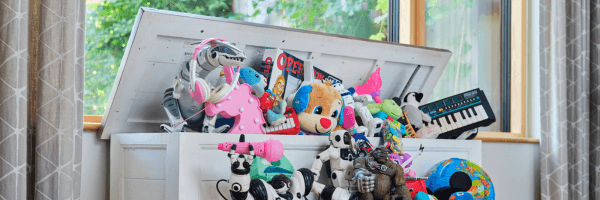
#5 Store properly
Saving children’s toys for future siblings is a fantastic idea. However, it’s important to store these properly – especially e-toys. The batteries should be taken out before being packed away. Batteries could leak and stop the toys from working in the future, so it’s worth taking the time to do it properly. As always, make sure you’re not throwing the old batteries away in the bin but recycling them, too.
#6 Focus
Studies show that having less mess around can create better focus. This means children will benefit from their play areas being kept tidy. The magic answer here is to ensure the number of toys you have doesn’t outweigh the space and storage you have to house them. When things start to overflow it’s most likely time for a declutter.
#7 Too many toys
Did you know too many toys can cause children stress? Think about when you have too many clothes in your wardrobe and you have to fight to find what you need. The choices are overwhelming and decisions are harder. This is the same feeling your child gets, only with their young developing minds, they can’t understand why. Ensure toys aren’t crammed in their storage spaces, check that they are easy to access and ensure the amount and the choices aren’t overwhelming.